SHIFT
The Odyssey of Cosmological Anisometropia
L’Odyssée de l’Anisométropie Cosmologique
( free download in the middle page)
Almost a century.
That is how long it took to build ΛCDM. A model taught in every university in the world, that seemed complete, coherent, definitive.
But now…
Tensions are cracking the edifice. H₀ diverges. Galaxies appear too massive, too mature, too early, and far too small. Every anomaly receives its parametric adjustment (dark matter, dark energy, inflation, accelerated growth) with no way to verify their existence. As for JWST, its images contradict the model’s flagship predictions.
The constraint is purely mathematical.
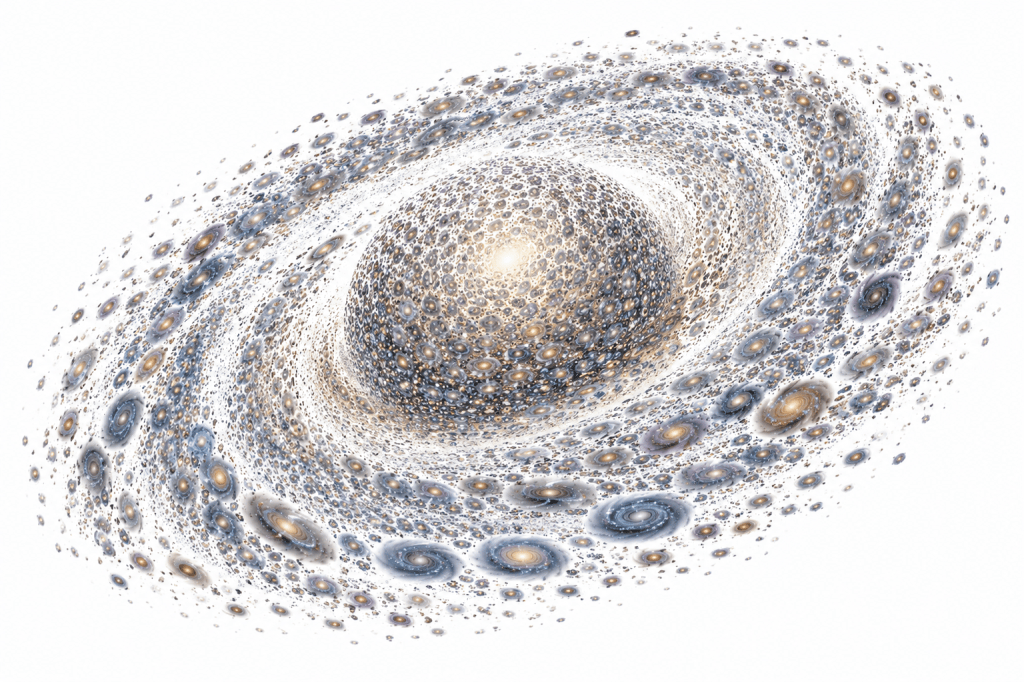
ΛCDM fixes the age of the universe at 13.8 Gyr. Consequence: no instrument can observe beyond the artificial wall of 13.8 Gly, the depth is locked. Yet when a telescope’s power increases without the theoretical depth moving, distant objects are forced to appear smaller and smaller. This is the mathematical anisometry of ΛCDM. As a result, distant galaxies, comparable to our nearby neighbours in morphology, chemical signatures, and maturity, appear 100× smaller than local objects. If we treat them as equivalent, 2 independent calculations estimate JWST’s true instrumental depth at ~55 Gly (4× the theoretical limit).
SHIFT’s predictions for the ELT are concrete, quantified, and verifiable.
With its resolving power, if the Universe is unbounded, the number of galaxies accessible to the ELT will leap to ~100,000 billion (vs ~2,000 billion for JWST, i.e. ×50). Accordingly, the ELT’s true instrumental depth could reach ~200 Gly (nearly 14× ΛCDM’s theoretical limit). Furthermore, the miniaturisation of distant galaxies, to keep fitting within the ΛCDM framework, would reach a factor of ~1,000. These predictions will be testable from the ELT’s very first observations.
SHIFT offers a new lens.
Not by denying the observations, but by reinterpreting them within a framework where they cease to be anomalies and become natural consequences. A quasi-static, infinite, self-balanced, ageless universe, that resolves in one stroke all the tensions accumulated by ΛCDM, with Copernican simplicity.
Presque un siècle.
C’est le temps qu’il a fallu pour bâtir ΛCDM. Un modèle enseigné dans toutes les universités du monde, qui semblait complet, cohérent, définitif.
Mais maintenant…
Des tensions fissurent l’édifice. La constante H₀ diverge. Des galaxies apparaissent trop massives, trop matures, trop tôt, et beaucoup trop petites. Chaque anomalie reçoit son ajustement paramétrique (matière noire, énergie noire, inflation, croissance accélérée) sans possibilité de vérifier leur existence. Quant au JWST, ses clichés contredisent les prédictions phares du modèle.
La contrainte est simplement mathématique.
ΛCDM fixe l’âge de l’univers à 13,8 Gyr. Conséquence, aucun instrument ne peut observer au-delà du mur artificiel de 13,8 Glyr, la profondeur est figée. Or quand la puissance du télescope augmente sans que la profondeur théorique ne bouge, les objets lointains sont contraints de paraître de plus en plus petits. C’est l’anisométropie mathématique de ΛCDM. Ainsi, les galaxies lointaines, comparables à nos proches voisines, (mêmes morphologies, signatures chimiques et maturité) apparaissent 100 fois plus petites que nos objets locaux. Si on les assimile comparables, 2 calculs indépendants estiment la profondeur instrumentale réelle de JWST à ~55 Glyr (limite théorique x 4).
Les prédictions SHIFT pour l’ELT sont concrètes, chiffrées, vérifiables.
Avec sa puissance de résolution, si l’Univers n’est pas borné, le nombre de galaxies accessibles à l’ELT va faire un bond à ~100 000 milliards.
(contre ~2 000 milliards pour JWST, i.e. x 50).
De fait, la profondeur instrumentale réelle de l’ELT pourrait atteindre ~200 Glyr (près de 14 fois la limite théorique de ΛCDM).
Par ailleurs, la miniaturisation des galaxies lointaines, pour continuer de s’inscrire dans le cadre ΛCDM, atteindrait un facteur ~1 000.
Ces prédictions seront testables dès les premières observations de l’ELT.
SHIFT propose un œil nouveau.
Non pas en niant les observations, mais en les réinterprétant dans un référentiel où elles cessent d’être des anomalies pour devenir des conséquences naturelles. Un univers quasi statique, infini, autoéquilibré, sans âge, qui résout d’un seul tenant toutes les tensions accumulées par ΛCDM, avec une simplicité copernicienne.

